

Zn-Al-Mg vs Galvanized Steel: 2026 Comparison, Cut-Edge Self-Healing, and Buyer's Checklist
Every galvanized steel structure has the same weak point: the cut edge. Shearing, punching, and drilling expose bare steel that has no zinc left to sacrifice, so red rust starts there years before the flat surface shows any distress. This is the single failure mode that has driven zinc-aluminum-magnesium coated steel — Zn-Al-Mg, or ZM — from a niche Japanese and Korean product into a mainstream specification.
In 2026 the material is no longer experimental. Global Zn-Al-Mg coated steel demand reached roughly USD 4.13 billion, market penetration climbed to about 28.5%, and Chinese capacity passed 3.5 million tonnes. This guide compares Zn-Al-Mg against hot-dip galvanized and Galvalume on the measures that decide real service life, explains how the cut-edge self-healing mechanism works, maps the common corrosion problems it solves, and gives buyers a specification checklist.
What Makes Zn-Al-Mg Coating Different?
A conventional hot-dip galvanized coating is essentially pure zinc. A Zn-Al-Mg coating adds magnesium and aluminum to the bath — typical commercial compositions sit around 1% to 3% magnesium and 1% to 6% aluminum, with the balance zinc, sometimes with a small silicon addition. That small chemistry change produces a completely different microstructure: instead of large zinc grains, the coating solidifies into a fine eutectic containing intermetallic phases such as MgZn2 and MgZn11.
Those phases are what create the effect the industry calls self-healing. When the strip is cut or punched, the exposed steel edge is surrounded by coating that contains magnesium. In the presence of moisture and oxygen, the magnesium-bearing phases react to form a dense, stable corrosion product layer — largely basic zinc compounds and magnesium oxide — that seals the exposed edge and slows further attack. On a galvanized edge, the zinc simply dissolves away with nothing replacing it.
The practical result is that a Zn-Al-Mg coating can deliver the edge protection of a much heavier galvanized coating at a fraction of the coating mass. Where a Z275 galvanized specification might be needed for a coastal installation, a ZM coating of 60 to 100 g/m² per side often performs comparably, which means thinner coating, better weldability, and less coating spalling during bending.
Common specifications include EN 10346 grades such as DX51D+ZM, ASTM A1046 and A1063 in North America, JIS G3323 in Japan, and GB/T 2518 in China. Always confirm which standard the mill certificate references, because coating mass designation conventions differ between them.
Zn-Al-Mg vs Galvanized vs Galvalume: Side-by-Side
The three coatings are not interchangeable upgrades of one another. Each wins in a different environment, and the decision usually comes down to whether the structure will be cut and drilled on site.
| Property | Hot-Dip Galvanized (Z) | Galvalume (AZ) | Zn-Al-Mg (ZM) |
|---|---|---|---|
| Coating composition | Approximately 100% zinc | 55% Al, 43.4% Zn, 1.6% Si | Zn with 1–3% Mg and 1–6% Al |
| Cut-edge protection | Sacrificial only; edge rusts first | Limited; aluminum-rich barrier does not self-heal | Self-healing reaction seals the exposed edge |
| Relative edge corrosion life | Baseline | Below baseline at edges, strong on flat surface | Typically 3 to 5 times baseline in cyclic tests |
| Flat-surface corrosion | Good | Very good in atmospheric exposure | Very good, plus better in humid and chloride environments |
| Formability and bend radius | Good | Coating can crack on tight bends | Fine eutectic resists cracking at tighter radii |
| Heat resistance | Up to roughly 200°C long term | Up to roughly 315°C | Comparable to galvanized, around 200–250°C |
| Typical application | General frames, fencing, light structures | Roofing and wall cladding | PV mounting, automotive, appliance, exposed steelwork |
| Relative material cost | 1.00 | 1.10 – 1.25 | 1.25 – 1.45 |
The cost column is the one buyers fixate on, and it is the one that most often misleads. A 30% to 45% coating cost premium looks significant per tonne, but the comparison should be made on coating mass required to reach a target service life. Because ZM achieves the same edge durability with a thinner coating, and because thinner coatings reduce spalling scrap in forming, the total cost per finished part frequently lands within a few percent of galvanized.
Common Coating Problems Zn-Al-Mg Solves
Field complaints about coated steel are remarkably consistent. The table below maps each problem to its mechanism and to how a Zn-Al-Mg specification changes the outcome.
| Problem | Why It Happens | How Zn-Al-Mg Responds |
|---|---|---|
| Red rust at cut edges and punch holes | Galvanized coating has no reserve at the exposed steel | Magnesium-bearing phases form a protective layer over the bare edge |
| Coating cracking on tight bends | Coarse zinc grains or brittle intermetallic layer | Fine eutectic microstructure tolerates tighter bend radii |
| White rust in humid storage | Condensation plus insufficient passivation | Chrome-free passivation combined with magnesium stabilization |
| Coating burn-off at weld zones | High local zinc vaporization during welding | Lower coating mass per square meter reduces fume and repair area |
| Alkaline and mortar contact attack | Zinc is amphoteric and dissolves in alkaline conditions | Improved but not immune; specify a barrier coating where contact is continuous |
| Weight and thickness reduction targets | Heavy coatings add mass and reduce forming yield | 30–60 g/m² per side can replace a much heavier galvanized coating |
One honest caveat: Zn-Al-Mg is not a universal replacement for stainless steel or for heavy-duty immersion service, and it still needs a barrier coating in continuously alkaline or acidic contact. It is a substantial improvement over galvanized in atmospheric and cyclic-wet service, not a new category of material.
The 2026 Market: Where the Volume Is Going
The global Zn-Al-Mg coated steel market stood at about USD 3.78 billion in 2025 and reached roughly USD 4.13 billion in 2026, a growth rate near 9.3%. Forecasts put the market at USD 5.81 billion by 2030, a compound annual growth rate around 8.9%. On the supply side, China's effective capacity now exceeds 3.5 million tonnes with output near 2.9 million tonnes and utilization around 83%, and the top five producers hold about 42% of capacity.
- Construction remains the largest outlet at roughly 55% of demand — about 1.6 million tonnes in 2026, up around 10% — driven by exposed steelwork, purlins, and building envelopes where cut edges are unavoidable.
- Photovoltaic mounting structures are the fastest-growing segment, with demand for Zn-Al-Mg steel strip in PV brackets exceeding 450,000 tonnes, up about 35%, because mounting rails are cut and drilled on site and then exposed for 25 years.
- Automotive consumption reached roughly 450,000 tonnes, up about 25%, with per-vehicle usage rising from around 12 kg to 15 kg as underbody and chassis components convert from galvanized.
- Appliance demand is about 350,000 tonnes, up 8% to 10%, concentrated in refrigerator compressor bases and washing machine outer drums, where penetration has reached roughly 22%.
- Product capability has moved as well: ultra-thin strip below 0.5 mm is now in volume production, tensile strength has passed 600 MPa, and elongation exceeds 18%, which opens structural applications that were closed to earlier ZM grades.
Trade policy is shaping the map too. Tariffs on coated steel have raised the cost of imported material in several markets and pushed investment toward regional capacity, so buyers who previously relied on a single distant mill are now qualifying a second source closer to the point of use.
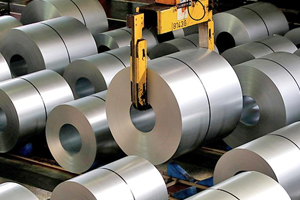
MESCO Steel supplies Zn-Al-Mg coated steel coil and sheet to EN 10346 and equivalent specifications, with coating masses matched to the exposure category rather than sold as a single stock grade. For PV mounting and exposed structural work we routinely help buyers compare ZM against a heavier galvanized specification on a cost-per-service-year basis, which is the only comparison that reflects what the material actually does on site.
How to Specify Zn-Al-Mg Coated Steel
- Start from the exposure category and the cut-edge density. A structure with hundreds of drilled holes in a coastal environment needs ZM far more than a fully welded, painted assembly does.
- Specify coating mass per side, not just the grade name — for example ZM 60, ZM 90, or ZM 120 — and confirm whether the figure is per side or total.
- Name the standard explicitly: EN 10346 DX51D+ZM, ASTM A1046 or A1063, JIS G3323, or GB/T 2518. Substitution between them is not automatic.
- State the substrate grade and quality — commercial, drawing, or structural — plus yield strength where the part is load-bearing.
- Confirm surface treatment: chrome-free passivation, anti-fingerprint, or oiled, depending on whether the part will be painted, handled, or stored.
- Ask for salt-spray and cyclic corrosion data for the specific coating mass offered, not generic marketing figures, and request the mill certificate with the shipment.
Frequently Asked Questions
Is Zn-Al-Mg steel better than galvanized steel?
For structures that are cut, punched, or drilled and then left exposed, yes — substantially. Zn-Al-Mg delivers roughly three to five times the edge corrosion life of galvanized in cyclic tests because the magnesium-bearing phases seal exposed steel. For fully painted, fully welded assemblies with no exposed edges, the advantage narrows and galvanized remains the lower-cost choice. The material is a targeted improvement, not a blanket replacement.
What does self-healing mean at the cut edge?
It is a chemical effect, not a physical one. When the strip is cut, magnesium-containing intermetallic phases in the coating are exposed at the new edge. In the presence of moisture and oxygen they react to form a dense, adherent corrosion product layer that covers the bare steel and slows further attack. The edge is not literally repaired, but it is protected in a way a pure zinc coating cannot manage, because zinc simply dissolves without leaving a barrier behind.
Can Zn-Al-Mg steel be welded and painted?
Yes, on both counts, with normal coated-steel precautions. Welding is actually easier than with heavy galvanized because the coating mass per square meter is lower, which reduces zinc fume and the size of the repair zone. Remove coating locally where a clean weld is required, and repair the affected area with a zinc-rich compound afterwards. For painting, specify a chrome-free passivated or anti-fingerprint surface and use a primer compatible with zinc surfaces; standard pretreatments for galvanized work apply.
Is the higher price of Zn-Al-Mg justified?
Compare cost per service year, not cost per tonne. Zn-Al-Mg typically carries a 25% to 45% premium over galvanized on coating cost, but it reaches the same edge durability with a much thinner coating — 30 to 60 g/m² per side often replaces a far heavier galvanized specification. Once you account for reduced coating mass, lower spalling scrap in forming, and deferred maintenance on exposed edges, the gap frequently closes to a few percent per finished part.
Which standard should I specify for Zn-Al-Mg coil?
Match the standard to your market and your fabricator. EN 10346 with a +ZM designation is the most widely recognized in Europe, the Middle East, and much of Asia; ASTM A1046 and A1063 apply in North America; JIS G3323 in Japan; and GB/T 2518 in China. Coating mass designation conventions differ between them, so always state whether the figure is per side or total and ask the mill to confirm the equivalence in writing before the order is released.
Zn-Al-Mg coating exists to solve one specific and very expensive problem: corrosion that starts at the cut edge. With penetration at roughly 28.5% in 2026, capacity above 3.5 million tonnes in China, and demand growing near 9% a year, it has moved from a premium experiment to a standard specification for photovoltaic mounting, automotive underbody, appliance components, and exposed steelwork. Specify it by exposure category and coating mass, and compare it against galvanized on cost per service year rather than cost per tonne.
Review our Zn-Al-Mg and coated steel coil range, read more coating selection and corrosion guides, or contact the MESCO Steel team for ZM coil to EN 10346 with coating masses matched to your exposure conditions and mill certificates included.