

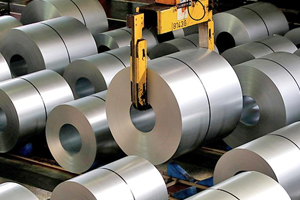
VCM Steel Sheet Defects 2026: Why Film Blisters and How to Stop It
VCM steel sheet rarely fails on the day it arrives. It fails three weeks later, on a formed part, at the draw corner or the bend line, in a lot that already passed incoming inspection. That delay is what makes vinyl coated metal so expensive to get wrong: the defect is latent, the material has already been cut, and the claim arrives after the production schedule has been committed.
The construction itself is simple enough. A steel substrate — hot-dip galvanised, galvannealed or cold rolled — receives a chromate passivation layer, then a heat-cured adhesive, then a PVC or PET film laminated at roughly 180 to 250 degrees Celsius. Each of those four interfaces can fail independently, and each failure looks different on the finished part. This guide separates the five root causes that account for most blistering and delamination complaints, sets out the process window that prevents them, and gives the incoming inspection protocol that catches the rest before the coil reaches the line.
The Five Root Causes of Blistering and Delamination
Field returns from appliance and furniture producers converge on a small number of mechanisms. The table below maps each one to how it presents on the part and what actually has to change in the specification or the process.
| Root cause | Mechanism | Where it shows up | What to change |
|---|---|---|---|
| Stamping and stretch stress | Film elongation is exceeded at draw walls and corners while the steel continues to flow | Blisters clustered at draw radii and part corners | Specify a higher-elongation film grade, review draw radius and blank-holder pressure |
| Bend radius below film capability | The steel conforms to the bend but the film cannot, so it cracks on the outside of the radius | Hairline cracks and whitening along bend lines | Set a minimum bend radius per film thickness and approve it with a coupon at production radius |
| Substrate cleanliness and passivation | The adhesive bonds to contamination or to a weak passivation layer rather than to metal | Large-area peeling starting from slit edges | Verify chromate passivation and residual oil; inspect coil edges before lamination |
| Excess thermal history | Over-cure, or a second pass through an oven, embrittles the adhesive and the film | Fine scattered blisters appearing after reflow or post-form baking | Log peak metal temperature per pass and count total heat cycles, not only the last one |
| UV degradation | Standard PET without a UV stabiliser yellows at around 500 hours of exposure and degrades over 6 to 18 months | Chalking and yellowing, then film loss on sun-facing parts | Specify UV-stabilised film for outdoor parts or panels adjacent to windows |
Note the asymmetry in that list. Three of the five causes are introduced after the coil leaves the mill — at the press, at the bender, or at a second oven pass. That is why a supplier can ship conforming material and a customer can still end up with a rejected lot, and why the argument is usually resolved by the bend coupon rather than by the certificate.
The Lamination Window: 180 to 250 Degrees and What Happens Outside It
Almost every adhesion complaint traces back to the same question: was the adhesive actually cured, or did it merely reach temperature? The distinction matters because the two failure modes sit on opposite sides of a narrow window.
Adhesive cure is a time-temperature integral, not a single number
Under-cure leaves the adhesive with low green strength. The coil looks correct, passes a quick peel check, and then lifts at the slit edges once it is cut and the internal stress is released. Over-cure is worse in a different way: the adhesive embrittles, peel strength drops, and the film can no longer move with the steel during forming, so blisters appear at exactly the points of highest strain. Because the reaction depends on both time and temperature, a line running faster at a higher peak metal temperature is not equivalent to a line running slower at a lower one. Log peak metal temperature on every pass, and add up the total heat history for any part that goes through more than one oven.
PVC versus PET, and what 25, 38 and 50 micrometres buy you
The film choice should follow the tightest forming operation and the service temperature, not the colour card. PVC film conforms better, which is why it dominates deep-matte and embossed finishes, but it has lower heat resistance and carries a plasticiser migration risk in high-temperature service. PET film resists heat and UV far better and holds colour consistency more tightly, but it elongates less and struggles at tight draw radii. Thickness follows the same logic: 25 micrometres is adequate for flat decorative panels, 38 micrometres covers most appliance panels, and 50 micrometres is the choice for deep draws or surfaces exposed to abrasion.
Specify thickness by the forming operation, not by the flat panel. A 25 micrometre film that performs perfectly on a flat side panel will fail at the first deep draw. State the tightest radius and the deepest draw on the purchase order and let the film be selected against those two numbers.
Incoming Inspection Protocol for VCM Coils
Six checks, run in this order, catch most of what a certificate will not tell you. Each one is cheap; the claim it prevents is not.
- Documentation match. Mill certificate and film technical data sheet checked against the purchase order for substrate grade, coating mass, film type, film thickness and adhesive class.
- Adhesion at both coil ends. Cross-hatch or peel test on samples from the head and the tail, because oven conditions drift across a long run.
- Bend coupon at the production radius. Test the radius the press will actually use, not a comfortable laboratory radius. This single check prevents the most common forming claim.
- Surface scan under raking light. Look for blisters, gel particles and scratches that a straight-on inspection misses.
- Film thickness across the strip width. Measure at the edges as well as the centre; edge thinning is a frequent and invisible cause of later failure.
- Colour and gloss against the approved standard. Assess under D65 lighting so that a batch-to-batch shift is caught before assembly rather than after.
Automated vision inspection on the lamination line reduces defect escape by 20 to 30% and is worth having, but it does not replace the bend coupon. Vision systems detect what is on the surface; forming failures are driven by geometry and strain, which only a coupon at the real radius will reveal.
Why Appliance Buyers Tightened VCM Specifications in 2026
The commercial context explains why a defect that was tolerated five years ago now triggers a rejection. The appliance VCM market is estimated at US$717.94 million in 2025, US$767.41 million in 2026, and US$1,397.84 million by 2035, a CAGR of 6.89%. A second estimate puts 2026 at US$838.98 million rising to US$987.64 million by 2032 at 2.83%, with Asia-Pacific holding 41% of demand. The divergence between those two growth rates is itself informative: value is growing faster than volume, which is what happens when specifications tighten rather than when shipments increase.
Several demand-side signals point the same way. Around 60% of appliance manufacturers now use VCM primarily to raise perceived appearance quality, 70% of consumers weigh appearance in the purchase decision, and roughly 35% of demand originates in smart appliances where the housing is a visible design element rather than a cover. At the same time, more than 40% of manufacturers are moving toward lower-emission coating systems, about 20% are actively evaluating alternative coatings, and 30% remain constrained by cost. The compliance layer has moved fastest of all: roughly 68% of appliance OEM procurement now requires environmental documentation with the order, against 45% five years ago.
That last figure changes the cost of a defect. A rejected VCM lot is no longer only a scrap cost; it breaks a documentation chain that the OEM has already committed to its own customer. This is why film grade, adhesive class and lamination records are increasingly specified in writing rather than agreed verbally, and why a supplier who can produce a peak-metal-temperature log is worth more than one who quotes a lower price per tonne.
Frequently Asked Questions
Can blistered VCM steel sheet be reworked?
No. The film cannot be re-bonded reliably, and re-lamination destroys the surface finish. Treat a blistered lot as a rejection and trace it back to the forming operation or the oven pass that caused it, because the same condition will repeat on the next coil from the same run.
Is PET film always better than PVC film?
No. PET wins clearly on heat resistance, UV stability and colour consistency, which is why it suits outdoor panels and high-temperature service. PVC wins on conformability, which is why it dominates deep-matte and embossed finishes and deep draws. Select against the tightest forming operation and the maximum service temperature, not against a general preference.
Why does VCM fail weeks after shipping instead of on arrival?
Adhesion develops and then decays over time under humidity and temperature cycling. A mildly under-cured adhesive can pass a 24-hour peel test and fail at seven days, and container conditions accelerate the process. Add a delayed peel check at seven days to the approval protocol for any new film and adhesive combination.
What film thickness should I use for a refrigerator door versus a washing machine top?
Both are typically served by 38 micrometres, which covers most appliance panels. Move to 50 micrometres where the part involves a deep draw or where the surface will see abrasion in service, and down to 25 micrometres only for flat decorative panels where formability is not stressed. State the tightest radius and deepest draw on the order so the film can be matched to them.
VCM steel sheet fails for five reasons, and three of them are introduced by the fabricator rather than the mill. Stamping strain, bend radius and accumulated thermal history account for most blistering claims, with substrate passivation and UV degradation covering the rest. Control the 180 to 250 degree lamination window as a time-temperature integral, choose PVC or PET against the tightest forming operation, and approve every new combination with a bend coupon at the real production radius plus a seven-day delayed peel check. With appliance VCM demand growing at 6.89% a year and 68% of OEMs now requiring environmental documentation, a documented process is as much a sales asset as a quality control.
Review our VCM steel sheet and coated steel range, read more coating and lamination guides, or contact the MESCO Steel team for VCM coil with specified substrate, film type, film thickness and lamination records supplied with each lot.