

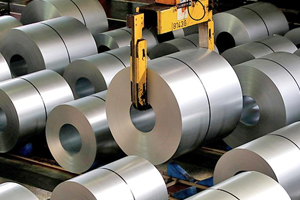
ASTM A463 Explained: Coating Weights T1-13 to T1-60
(English, publish-ready)
Buyers who ask for ASTM A463 coating weight designations are rarely looking for a definition of aluminized steel. They are trying to write a request for quotation that a mill, a service centre and a trading company will all interpret in exactly the same way. A single missing character in a coating designation — T1-25 written as T1 25, AS120 written instead of a T1 code, or no designation at all — can change the coating mass, the heat performance and the price of the coil you receive. This guide explains what ASTM A463 covers, how the T1 coating weight designations from T1-13 to T1-60 are structured, and how to state them correctly in an RFQ.
What ASTM A463 actually covers
ASTM A463 / A463M is the specification for steel sheet that is aluminum-coated by the hot-dip process. It separates the product into two types that are not interchangeable:
Type 1: aluminum-silicon coated sheet
Type 1 is produced in a bath of approximately 91% aluminium and 9% silicon. The silicon addition restricts the growth of the brittle iron-aluminium intermetallic layer, which is what makes the coating workable and, critically, heat resistant. Cleveland-Cliffs' ALUMINIZED TYPE 1 STEEL product data sheet (March 2025) lists a continuous service limit of 1250 °F / 677 °C and states that below 800 °F / 427 °C the surface reflects up to 80% of radiant heat. Both figures are conditional: the reflectance claim applies below 427 °C, and should never be printed as an unconditional "80% heat reflection" claim. [Source: Cleveland-Cliffs, ALUMINIZED TYPE 1 STEEL, 2025-03; ASTM A463]
Type 2: commercially pure aluminium coated sheet
Type 2 uses a commercially pure aluminium bath and is selected primarily for atmospheric corrosion resistance in outdoor exposure — roofing, cladding, grain bins and similar structures. It is not the heat-resistant grade. A recurring error in supplier literature is to describe Type 2 as the high-temperature option; if a quotation arrives with Type 2 offered for an exhaust or oven application, that is a specification error, not an alternative product.
Buyer note: Confirm the exact standard title and the current revision of ASTM A463/A463M before citing it in a contract.
Decoding the T1 coating designation
What the designation number means
The T1 series is the coating weight designation system used for Type 1. Cleveland-Cliffs' data sheet lists designations across the range T1 13 to T1 60, with T1 25 and T1 40 among the commonly specified grades. The number is a designation, not a thickness in millimetres and not a percentage: a higher designation corresponds to a heavier coating. What a buyer must never do is assume that a T1 number converts one-to-one into a European AS coating code, or into a coating mass in g/m², without checking the governing standard or the mill certificate.
Three practical rules follow:
- Always write the designation in full, including the
T1-prefix, in the RFQ subject line and in the specification table. - State the unit system. ASTM A463/A463M has both inch-pound and SI editions; a coating mass quoted without units is not a specification.
- Ask for the coating mass on the MTC, so the designation and the measured value can be reconciled on receipt.
T1 designations at a glance
| Designation | Coating mass (g/m², both sides) | Typical selection context | Buyer check |
|---|---|---|---|
| T1-13 | On request | Light coating, cost-sensitive formed parts | Confirm formability and service life with the mill |
| T1-25 | On request | General heat-exposed components | Most frequently quoted; verify against MTC |
| T1-40 | On request | Exhaust systems, heat shields, oven parts | Common export specification; state explicitly in RFQ |
| T1-60 | On request | Heaviest coating in the listed range | Confirm availability and lead time before committing |
Coating mass values are available on request and must be confirmed on the mill test certificate; no verified conversion table is reproduced here. The designations and the T1 13–T1 60 range are taken from the Cleveland-Cliffs product data sheet (2025-03). ASTM A463 is the governing standard.
ASTM T1 codes versus EN and mill AS codes
European and mill-specific designation systems use AS codes — for example DX53D AS120 — to describe aluminium-silicon coated press-hardening and exhaust grades. These codes belong to a different standard family (EN 10346 and related mill specifications) and express coating mass differently from the ASTM T1 series. Treating AS120 as equivalent to a specific T1 designation is the single most common cause of a wrong coil being shipped against an otherwise correct order.
| System | Example | Governing document | What to verify |
|---|---|---|---|
| ASTM T1 | T1-25, T1-40 | ASTM A463 / A463M | Designation + measured coating mass on MTC |
| EN / mill AS | DX53D AS120 | EN 10346 / mill specification | Coating mass definition, single-side or both-sides basis |
| Generic supplier "aluminized" | "aluminized steel, 120 g/m²" | None | Always reject: no standard, no type, no designation |
How to specify coating weight in an RFQ
The coating designation is one line in a larger specification. A workable RFQ line reads: "Aluminized steel coil, ASTM A463 Type 1, designation T1-40, base grade, thickness × width, coating mass per MTC, mill test certificate EN 10204 3.1 ". The full 12-field checklist is in our Aluminized Steel Coil RFQ Checklist: 12 Specs to Specify.
Four fields interact directly with the T1 designation:
- Base grade and formability — a heavier coating can limit severe drawing; state the forming operation, not just the grade.
- Thickness tolerance — coating mass is measured on the coated product; clarify whether thickness is quoted on the substrate or the total.
- Surface condition and edge — slit edges expose bare steel; see the cut-edge discussion in our defect and inspection guide.
- Inspection documents — without a coating mass entry on the MTC, the designation is unverifiable after shipment.
Five specification mistakes we see repeatedly
- Writing "aluminized steel" with no type. Type 1 and Type 2 serve different purposes; the word alone is not a specification.
- Mixing T1 and AS codes in one line. Pick one standard system and keep it consistent through the PO, MTC and packing list.
- Omitting the temperature condition on heat claims. "Reflects up to 80% of radiant heat" is only valid below 427 °C per the Cleveland-Cliffs data sheet.
- Quoting 650 / 800 / 900 °C from marketing pages. Use the 677 °C figure with its source, or state no number at all.
- Assuming food-contact compliance.
Verification before shipment
Ask for the mill test certificate to state the standard, the type, the coating designation and the measured coating mass. Where the order is for a heat-exposed component, add a third-party inspection clause covering coating mass measurement and visual surface inspection; our inspection guide describes the defect classes to reference. Retain the sample and the MTC against the production lot so that any later claim has a documented baseline.
Frequently asked questions
What does the number in T1-40 mean?
It is an ASTM A463 coating weight designation, not a thickness or a percentage. Higher designations in the T1 13–T1 60 range correspond to heavier coatings. For the exact mass in g/m², refer to the ASTM table or the mill data sheet and confirm it on the MTC.
Is Type 1 the same as AS120 or DX53D AS120?
No. T1 codes belong to ASTM A463; AS codes belong to EN / mill designation systems. They are not directly interchangeable. Ask the supplier for a documented cross-reference and verify it against the MTC.
Can Type 2 replace Type 1 in an exhaust application?
No. Type 1 (Al-Si) is the heat-resistant product with a published 677 °C service limit; Type 2 (commercially pure aluminium) is selected for atmospheric corrosion resistance. They are not substitutes.
What is the maximum service temperature of Type 1 aluminized steel?
Cleveland-Cliffs' product data sheet gives 1250 °F / 677 °C. Other figures circulating in supplier literature (650, 800, 900 °C) are inconsistent with this source; use a sourced figure in contracts.
Do I need to state coating weight if I already state the grade?
Yes. The grade describes the substrate; the T1 designation describes the coating. Both are required for a reproducible quotation.
Will a mill certificate show the coating designation?
Ask for it explicitly.
Request the specification sheet
Send us your target designation, grade and dimensions and we will return a specification sheet with a sample and mill test certificate. Request a free sample and MTC — mesco@mescogroup.com.cn. For a full buyer reference, see the Aluminized Steel pillar page.